Trade Pact Under Fire: Opposition Flags Risks to Energy Security, Data Sovereignty and Farmers
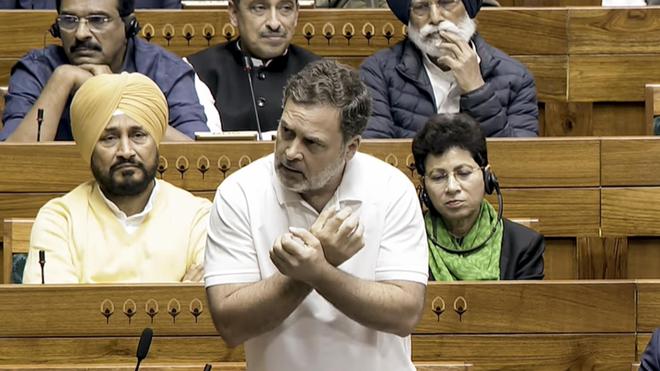
A heated exchange in the Lok Sabha has brought India’s interim trade understanding with the United States under renewed scrutiny. During the Union Budget debate on February 11, 2026, senior opposition leader Rahul Gandhi accused the NDA government of endangering India’s energy security, data governance framework and agricultural stability through the bilateral arrangement. Framing the agreement as a strategic concession, he argued that it exposes vulnerable sectors—particularly small farmers—to external pressures. The government has defended its broader economic strategy as reform-oriented and growth-driven, but the controversy underscores the political sensitivity surrounding trade liberalisation in a complex global environment.
Parliamentary Flashpoint During Budget Debate
The Union Budget discussion in the Lok Sabha escalated into a broader critique of India’s trade policy when Rahul Gandhi alleged that the government’s interim trade agreement with the United States compromises core national interests. The remarks came after procedural friction earlier in the session had prevented him from speaking during the Motion of Thanks to the President’s address.
Using the budget debate as a platform, he argued that the agreement represents a structural shift in economic alignment, one that could carry long-term consequences for strategic autonomy and domestic resilience. His intervention intensified partisan tensions and reframed fiscal deliberations around trade and sovereignty.
Energy Security at the Centre of the Debate
One of the principal concerns raised relates to energy security. India remains heavily dependent on energy imports to meet domestic demand. Critics of the agreement contend that closer trade alignment with a single strategic partner may narrow procurement flexibility or influence pricing frameworks over time.
Energy diversification has long been central to India’s macroeconomic stability strategy. Any perceived erosion of negotiating leverage, opposition leaders argue, could expose the country to external supply disruptions or geopolitical volatility.
Policy experts note that the actual impact of such agreements depends on the fine print—particularly tariff schedules, regulatory harmonisation clauses and investment protections. Without full public clarity on sector-specific commitments, assessments remain speculative.
Data Governance and Digital Sovereignty
The debate also extends to data security and digital regulation. As India positions itself as a global digital economy leader, data localisation norms, cross-border data flows and intellectual property protections have become critical policy issues.
Rahul Gandhi alleged that the trade understanding risks diluting India’s control over digital infrastructure and sensitive information flows. He suggested that premature commitments in digital trade could constrain future regulatory autonomy.
Economists, however, observe that digital trade frameworks can attract foreign investment and improve compliance standards if structured carefully. The tension reflects a broader global dilemma: balancing economic integration with sovereign oversight in the digital age.
Farmers and Agricultural Market Access
The most politically charged aspect of the criticism concerned agriculture. Addressing the House, Gandhi warned that Indian farmers face heightened vulnerability under expanded trade access for foreign agricultural products.
“For the first time in history, our farmers are facing the storm,” he said, describing the agreement as opening “the doors to crush our poor farmers.”
Agriculture remains a sensitive pillar of India’s socio-economic structure, employing a significant share of the population. Even incremental tariff adjustments or market access provisions can influence domestic pricing and competitiveness.
Trade negotiators typically incorporate safeguard clauses, phased reductions and quota systems to cushion potential disruptions. Nonetheless, opposition leaders argue that small and marginal farmers may lack the scale to withstand intensified competition.
Political and Economic Implications
By linking trade policy to energy strategy, digital governance and agricultural livelihoods, the opposition broadened the scope of the budget debate beyond fiscal allocations. The episode illustrates how trade agreements increasingly intersect with national security and domestic welfare concerns.
The NDA government has consistently portrayed its economic agenda as reform-driven, aimed at accelerating growth, expanding exports and integrating India more deeply into global supply chains. Supporters argue that strategic partnerships can enhance capital inflows, technology transfer and market access.
Critics counter that economic openness must be calibrated to protect vulnerable sectors and preserve policy autonomy.
The Road Ahead
Interim trade agreements often serve as stepping stones toward comprehensive economic partnerships. Their long-term impact depends on implementation, transparency and the adaptability of domestic industries.
The Lok Sabha exchange signals that future negotiations will face rigorous political scrutiny. As India navigates a shifting global order marked by economic realignment and technological transformation, balancing growth ambitions with sovereign safeguards will remain a defining policy challenge.
The debate is unlikely to subside soon. Instead, it reflects a deeper national conversation about how India positions itself in the global economy while protecting strategic interests at home.