Political Flashpoint at AI Summit: Youth Congress Protest Over U.S. Trade Pact Sparks Arrests and War of Words
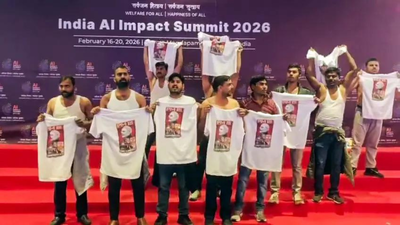
A protest staged by members of the Indian Youth Congress at the AI Impact Summit in New Delhi escalated into a political confrontation on February 20, 2026, resulting in four arrests and multiple detentions. Demonstrators opposed the India-U.S. trade agreement, accusing the government of compromising national interests. The ruling Bharatiya Janata Party condemned the demonstration as an attempt to damage India’s global standing, while senior leaders from the Indian National Congress defended it as legitimate democratic dissent. Police have registered an FIR citing criminal conspiracy and unlawful assembly.
Protest Disrupts High-Profile Technology Forum
A political demonstration disrupted proceedings at the AI Impact Summit in New Delhi on Friday afternoon, underscoring the deepening political fissures surrounding the recently negotiated India-U.S. trade pact. Around 12.30 p.m., a group of Youth Congress activists staged a coordinated protest inside Hall-5 of the exhibition venue.
The protesters removed their white T-shirts, turned them inside out to reveal printed slogans and images critical of the bilateral trade arrangement, and raised chants that briefly halted activity within the hall. The episode caused a visible commotion at what was intended to be a technology-forward forum highlighting India’s artificial intelligence ambitions.
Security personnel intervened promptly, escorting demonstrators out of the premises. The disruption, though short-lived, quickly reverberated beyond the venue, triggering sharp political responses at the national level.
Arrests and Legal Action
Delhi Police arrested four Youth Congress office-bearers — Krishna Hari and Kundan Yadav from Bihar, Ajay Kumar from Uttar Pradesh, and Narsimha Yadav from Telangana. An additional 15 protesters were detained, including Youth Congress national president Uday Bhanu Chib and national general secretary Vikas Chhikara. All were taken to Tilak Marg police station.
Authorities registered a First Information Report alleging criminal conspiracy, unlawful assembly, common intention, and causing injury to a public servant. Law enforcement officials maintained that the protest violated security protocols at a high-profile international event and warranted swift action to preserve order.
Political Fallout Intensifies
The incident quickly transformed into a broader political confrontation. Union Minister Ashwini Vaishnaw criticized what he described as “negative politics,” asserting that attempts to disrupt a globally attended summit risked undermining India’s technological narrative at a critical juncture.
The Bharatiya Janata Party escalated its rhetoric, accusing senior Congress leadership of orchestrating the protest to malign the country’s image. Party spokesperson Sambit Patra alleged that the action had been planned at the residence of Leader of Opposition Rahul Gandhi in the presence of Sonia Gandhi and Priyanka Gandhi Vadra, characterizing the move as politically motivated and detrimental to national interests.
Congress Defends Democratic Dissent
In response, Pawan Khera, who heads the Congress party’s media and publicity department, defended the Youth Congress workers, framing the protest as constitutionally protected dissent. He argued that demonstrations are effective only when they command public and media attention.
“Protests are meant to be visible,” Khera said, dismissing criticism that the venue was inappropriate. According to him, dissent must be expressed in spaces where policy debates are actively shaping public discourse.
Trade Pact at the Core
The protest highlights simmering unease within sections of the opposition regarding the economic implications of the India-U.S. trade agreement. While the government has portrayed the deal as a strategic step toward deeper market integration and expanded export opportunities, critics argue that certain concessions could adversely affect domestic industries and labor segments.
Analysts note that trade agreements of this scale inevitably become political flashpoints, particularly in an environment where economic sovereignty and global alignment remain contentious themes.
Democratic Optics and Global Signaling
The episode underscores the delicate balance between political expression and diplomatic optics. Hosting a global technology summit is both an economic and reputational exercise, projecting India as a stable and innovation-driven economy. Simultaneously, visible dissent reflects the vibrancy—and volatility—of the country’s democratic fabric.
As legal proceedings unfold and political rhetoric intensifies, the protest at the AI Impact Summit serves as a reminder that economic diplomacy often intersects with domestic political contestation.