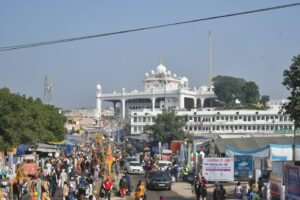
Punjab Designates Three Sikh Heartlands as “Holy Cities,” Imposes Ban on Meat, Liquor & Tobacco

In a landmark unanimous resolution, the Punjab Assembly declared Amritsar’s Walled City, Anandpur Sahib, and Talwandi Sabo as holy cities, imposing a full prohibition on the sale and consumption of meat, liquor, tobacco, and other intoxicants. The decision, led by Chief Minister Bhagwant Singh Mann, was taken during a special session held in Anandpur Sahib in observance of the 350th martyrdom anniversary of Guru Tegh Bahadur. The move is being framed not only as a religious affirmation but also as part of a broader push to preserve the state’s civilisational heritage and boost religious tourism.
The Resolution: What Was Decided
- During a specially convened session of the Punjab Vidhan Sabha, CM Bhagwant Singh Mann introduced a resolution to accord holy city status to three significant Sikh sites.
- The Assembly passed the resolution unanimously, signifying cross-party support.
- Under this resolution, a complete ban will come into force for the sale and use of meat, liquor, tobacco, and other intoxicants in these designated areas.
- These three places host three of the five Takhts of Sikhism:
- Sri Akal Takht Sahib in Amritsar,
- Sri Damdama Sahib in Talwandi Sabo (Bathinda), and
- Takht Sri Kesgarh Sahib in Anandpur Sahib.
Symbolism and Cultural Significance
- According to CM Mann, these cities are not simply religious centres; they are “symbols of our civilisational heritage.”
- The declaration is framed as a long-standing aspiration of the Sikh community. Mann noted that for decades, people had pressed for holy-city status.
- To shepherd this change, the government will form an interfaith committee comprising representatives from all faiths to oversee religious institutions in these cities.
- There is also a stated commitment to invest in these areas for “holistic development, cleanliness, security, and the promotion of religious tourism.”
Political Context & Implementation Challenges
- The special Vidhan Sabha session was timed to coincide with the 350th martyrdom anniversary of Guru Tegh Bahadur, underlining the symbolic weight of the decision.
- Notably, this was the first time the Punjab Assembly convened outside its capital, Chandigarh, held instead at Anandpur Sahib’s Bhai Jaita Ji Memorial Park.
- Opposition parties raised practical questions: For instance, whether the entire city of Amritsar is covered or just specific precincts.
- The CM responded that shopkeepers affected by the ban (meat, alcohol, tobacco vendors) would be rehabilitated.
- The Assembly’s Speaker later clarified that the reference is specifically to the walled city of Amritsar — not the entire city — after initial ambiguity.
Strategic Implications & Broader Impact
- Cultural Preservation: By legally formalising their sacred status, these sites are being culturally protected. The ban reinforces a vision where spiritual heritage and daily life converge.
- Religious Tourism: With stricter codes and clearer identity, these holy cities may attract more pilgrims. The government explicitly ties the decision to promoting “religious tourism.”
- Stakeholder Resistance: While this move may please religious constituencies, the economic cost to small-time vendors could be non-trivial. The proposed rehabilitation scheme will be critical to its political sustainability.
- Governance Precedence: Punjab’s decision may inspire other regions with religious significance to consider similar protective declarations; it raises questions about the balance between religious sentiment and economic freedoms.
- Social Messaging: This act sends a strong normative message — promoting abstention in sacred precincts — which could have ripple effects on public morality discourse.
Conclusion
The Punjab government’s decision to declare Amritsar’s walled city, Anandpur Sahib, and Talwandi Sabo as holy cities marks a historic confluence of religion, heritage, and governance. By enacting a blanket ban on intoxicants in these precincts, the state is not only facilitating a spiritual code of conduct but also aiming to preserve cultural identity and boost pilgrimage-driven economic activity. How effectively the policy will be enforced — and how the promised welfare for displaced vendors will unfold — will determine its long-term success.